SERVICES · SOFTWARE ENGINEERING.
We're nearshore software developers in Mexico. We build the software that runs critical operations: apps that work without signal and agents that coordinate teams in the field, on the systems you already use.
INDUSTRIES.

CONDITIONS.
A deployment can't hold up the day's sales, and the system that runs your billing can't be switched off to migrate it.
The technician walks into a warehouse with no signal and still has to keep working.
We build with those conditions from day one.
SERVICES.
We design and build mobile and web apps, with the backend that runs them. Your people use them every day because they get the job done.
If you already have software that works, we build on it and connect it to what's new. If not, we build it from scratch.
When a piece of your ecosystem stops delivering, we build its replacement and connect it to the rest without stopping the operation.
We integrate AI into your apps and your backend. We build agents that handle and coordinate tasks in the channels your team already uses.
TECHNOLOGY.
On Android we build native with Kotlin and Jetpack Compose, and keep the data on the phone with Room until the connection comes back. On iOS, Swift; with Kotlin Multiplatform when sharing code pays off.
Interfaces in TypeScript with React, Next.js, Astro and Tailwind. Backend in Node.js, Python with FastAPI, Go and .NET, to connect with what already runs in your operation.
PostgreSQL, SQL Server, Firestore and Redis. We deploy with Docker and Kubernetes on Google Cloud, Azure, AWS and Cloudflare, in the cloud your team already uses.
Agents built on language models that work in WhatsApp, Microsoft Teams and Outlook, and by voice with ElevenLabs. We connect them to your systems with MCP and add computer vision when the job is reviewing images.
PROCESS.
Build
We design and stand up the whole system, on standards your team can hold afterwards.
Transfer
Your team takes over the day-to-day operation, on an architecture it can maintain without depending on us.
HANDOVER.
We write code and documentation your people can maintain. When we hand it over, your team runs it without depending on us day to day.
Documentation
Of the system and how it runs, written for whoever will maintain it.
Training
Your team works with ours during the build and learns the architecture before taking it over.
Code ownership is agreed before we start and written into the contract.
DATA.
Founded
Engineers
Projects delivered
CASES.
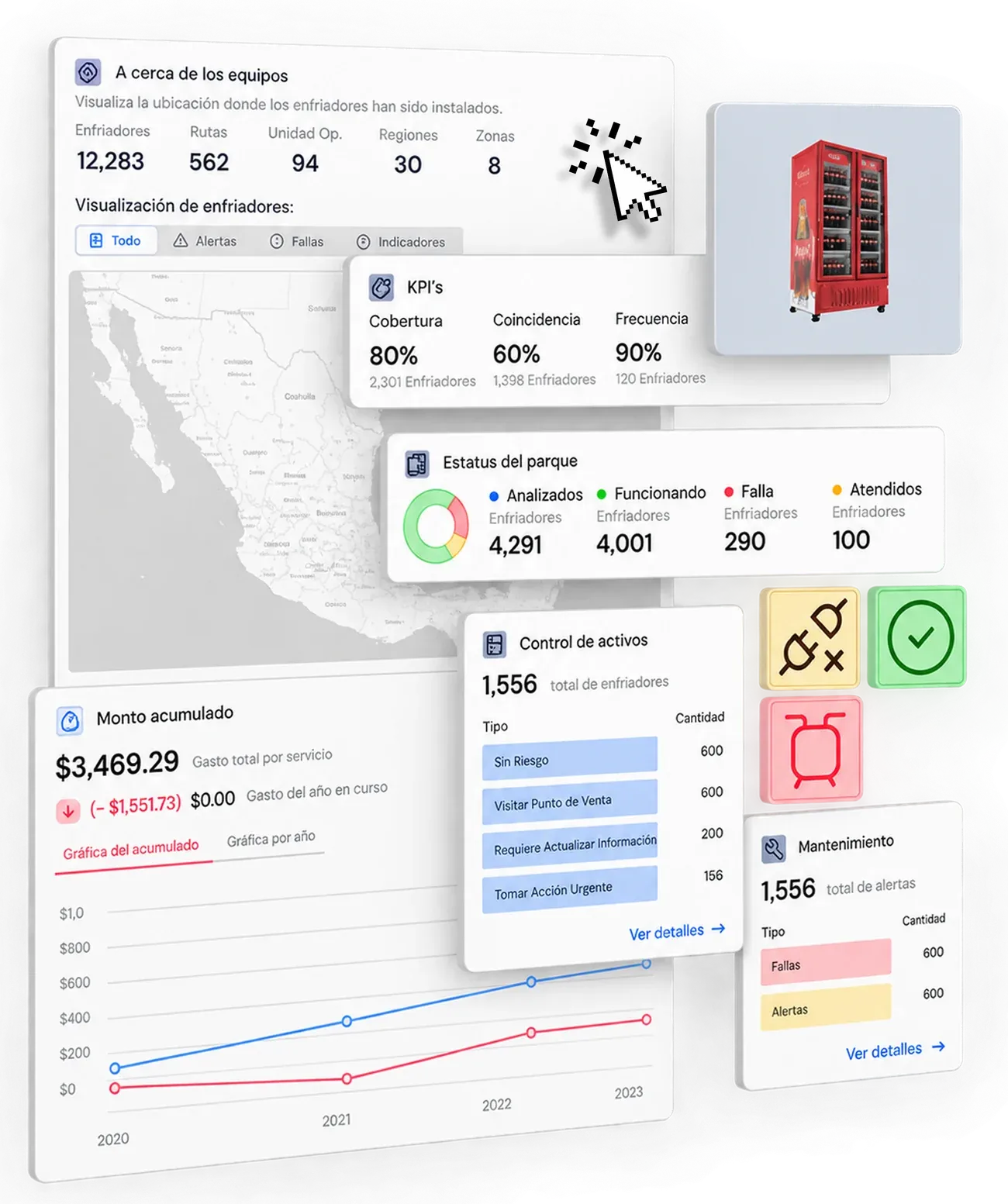
Case · Refrigeration
INVESTMENT.
Every project starts with the Build Plan: ten days of work with your people to define what to build and how. It has a closed price we agree on the call, paid before we build. The Plan sets the team size and how long the build takes, so you know the order of the investment before committing.
Build Plan, at a closed price
Dedicated to your project, paid monthly
QUESTIONS.
It depends on the scope, which is why we don't publish a figure. Every project starts with the Build Plan: ten days of work with your team, at a closed price we agree on the call. When it ends you know how many people the build takes and how long it lasts, which is what sets the investment.
With a team dedicated to your project and a monthly payment. It is the arrangement we work with almost always; if your operation needs a different one, we agree on it before we start.
The Build Plan takes ten days. How long the build takes depends on what has to be built: the Plan sets it, along with the team size, before you commit.
In the first week we map with your people how the operation runs today and test a solution with the people who will use it. In the second we turn it into a specification and a phased plan with its timelines, built on the systems you already have. On day ten we present the plan to your team.
Code ownership is agreed before we start and written into the contract. At handover, your team receives the system documentation and the training to sustain it.
Yes. We connect with what already runs in your operation and deploy on the cloud your team already uses. You don't need to replace what already works to get started.
Yes, from day one. Your team works with ours and reaches handover already knowing the architecture it will sustain.
Your team keeps the system and runs it with what it learned working alongside ours. If you would rather we keep building with you, that phase is called Retain and is billed monthly.
Tell us what you need to build and where your team stands. In 30 minutes we'll tell you how we'd build it and who sustains it afterwards.